I was born and raised in Oregon and have lived here all my life save for two years in Europe, a ten-year layover in Boston, and some overseas trips that have lasted anywhere from three weeks to three months.
FAMILY
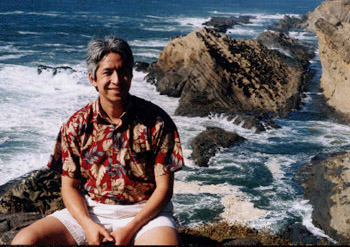
My father, Don Loftus, came from Norwegian and general European stock, and was born in Fairbanks, Alaska. He tuned and repaired pianos, taught music, and played piano and other instruments (for instance, tuba in a Dixieland band for many years).
My mother, Mitzi, was the eighth child of Japanese immigrants who settled in Hood River, Oregon. Mom spent the duration of the Second World War behind barbed wire in her native country while two of her older brothers fought in the Pacific in U.S. Army uniform. (She describes her family and wartime experiences in a self-published memoir entitled Made in Japan and Settled in Oregon.) Later, she was graduated Phi Beta Kappa from the University of Oregon, won a Fulbright scholarship to teach English in Japan, and taught high school English, French, and many other subjects on a full-time and substitute basis in Oregon.
CHILDHOOD
My first ten years I lived in Oregon. In 1969, the family (my parents, myself, and two younger brothers) drove across the U.S., hopped a Yugoslav freighter, and traveled across Europe (after landing in and driving around Morocco for a week or two). Dad found a job teaching at a U.S. Army dependent school in Germany and we stayed there two years, taking vacations to England, Scandinavia, Italy, Yugoslavia, and Greece. I was especially charmed by southern Norway; the Italian coast south of Naples; Dubrovnik, Plitvice, and the island of Hvar on the Adriatic coast of Yugoslavia; and Brittany and Normandy. (At age 11, I was naturally a D-Day invasion nut).
TEEN YEARS
Returning to the states in 1971, we settled on the south coast of Oregon. After my Dad bribed me to jog a few miles on a regular basis by raising my allowance, I developed into a distance runner. I met Steve Prefontaine my first week of high school (he was 8 years older), broke his freshman two-mile record (he had run a 10:08, I clocked a 9:59.4), and subsequently had a decent running career in highly competitive District 5AAA, which included powerhouse South Eugene and routinely had half a dozen runners who would have been state champions in most other states of the union. (My best times turned out to be 9:19.5 for the two mile, about a 4:26 in the mile, which I didn’t like and ran only rarely.) I also performed traditional Scandinavian folk dances in my teens
HARVARD
After graduating from high school I went to the East Coast to study English and American literature at Harvard. I received a bachelor’s degree magna cum laude in 1981 after writing a thesis on John Fowles’s novel The Magus. Fowles later read a copy of it and sent me a complimentary note. I also made a few bucks on it in 2000-2001 by selling copies through the Fatbrain EMatters site on the World Wide Web; it’s no longer there — cut with all the other low-volume movers — but I’ll email you a copy for free if you ask nicely.
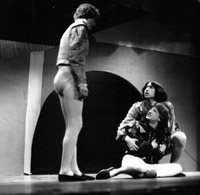
Among my other college adventures, I appeared briefly on stage with Estelle Parsons in “Miss Margarida’s Way,” shot black-and-white photos of my heroes Jules Feiffer and Harlan Ellison, and acted in college productions of Camus’s Caligula, T.S. Eliot’s Sweeney Agonistes, and Romeo and Juliet (typecast as nice guy Benvolio — that’s me with the long black hair, holding the dying Mercutio as Romeo looks on; the Mercutio, by the way, is Jonathan Prince, who went on to a television acting career and in 2002 brought the lovely show “American Dreams” to the air in his role as creator, writer, and executive producer).
I also joined the Black Jokers and became a Morris dancer and recorded a number of books for the Massachusetts Association for the Blind, including John Kennedy Toole’s Confederacy of Dunces, John Jakes’s North and South, Julian Jaynes’s The Origin of Consciousness in the Breakdown of the Bicameral Mind, and The Happy Hustler by a male Xaviera Hollander named Grant Tracy Saxon. Someone also had me record a walking tour of the Boston University campus for the purpose of introducing it to incoming blind students; I wonder whether it’s still being used?
BOSTON AFTER COLLEGE
I stayed on in Boston for six years after college, working for a law printer and small press, where I edited and proofed a number of books, such as Boston Fire Commissioner Leo Stapleton’s memoir, Thirty Years on the Line. My boss commissioned me to write two books for Quinlan Press, Boston College High School 1863-1983 and The Unofficial Book of Harvard Trivia. During those years I lived in Central Square, Cambridge; East Boston, Allston, and Somerville; and, for one glorious year, in the North End just a few doors away from the Paul Revere house — and more important, just around the corner from the Daily Catch, Piccola Venezia, and numerous other wonderful eateries..
Although I had refused to learn to drive for 27 years, let alone obtain a driver’s license, I realized that if I wanted to explore a possible career in journalism, I would have to get wheels. So I did, and in early 1987 became a stringer for the Saugus Prime Times (a small weekly in a suburb north of Boston), as well as selling free-lance pieces to the Boston Herald, the Middlesex News, and Harvard Magazine.
BACK HOME TO OREGON: ROSEBURG
The summer of 1987 (my first summer as a driver), I drove across the country to Oregon in order to look for a full-time job at a newspaper. The Roseburg News-Review in southern Oregon obliged. My first day of work was Black Monday, October 19, 1987 — a happy day for me! For more than three years I covered police and medical news, then municipal government, schools, and human interest in north Douglas County towns. My wry police log, filled with piquant details, won a loyal following. I also reviewed concerts, films, plays, and books, and wrote some three dozen op-ed columns, which attracted more angry letters to the editor than all the rest of the staff combined.
While at the Roseburg paper I got to interview mystery writer M.K. Wren, actor Jeff Daniels, drummer Robbie Bachman, songwriter and performer Hoyt Axton, and author Ken Kesey. The US Information Agency took note of my review of the Sofia Chamber Orchestra (which had been touring the U.S. with the Community Concert series) and had me write an expanded piece for Dialogue, a Bulgarian-language magazine published in Vienna and distributed in Bulgaria — a 600-dollar commission!
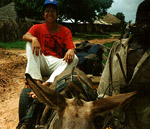
In the summer of 1989 I took a three-month unpaid leave of absence to tromp around West Africa (Senegal, the Gambia, Mauretania, Guinea-Bissau, and Mali). In the photo at right, I am crossing the border between Senegal and Guinea-Bissau via donkey cart. You can read the series of columns I wrote about my observations and experiences in West Africa beginning here.
I also spent a couple weeks in August 1990 visiting old friends in Boston and my brother in Puerto Rico. While in Roseburg I sang and danced in two productions of Gilbert & Sullivan (member of the sailors’ chorus in “Pinafore,” the Chief of Police in “Pirates”), had four roles in “Annie” (Apple Peddler, Warbucks servant, Assistant Secretary of the Treasury Morgenthau, and radio sound man), and played the lead in Alan Ayckbourn’s “The Norman Conquests.” I also sang second tenor in the Vintage Singers, a chamber choir under the direction of the late and much beloved Steve Biethan, which in 1990 took me to the International Choral Festival hosted by the University of Montana in Missoula, and the stage of Carnegie Hall in 1991.
FINALLY SETTLED IN PORTLAND
I moved to Portland at the beginning of 1991. I love this city: Portland is the biggest small town I’ve ever known — it doesn’t crush me the way other big cities have (even wonderful Boston), and the forest comes right down into the heart of it. Ocean beaches, mountains, high desert are all within an hour or two’s drive. (Not that I’m much of a hiking and camping kinda guy, to be honest. It’s just nice to look at them now and then and to know they’re there.)
Less than six weeks after arriving in town I met my future wife, Carole Barkley. We married in August 1993, honeymooned in southeastern Alaska, and made subsequent trips to Estonia (for the National Folk Song and Dance Festival) and St. Petersburg in 1994, Greece in 1997, and Washington DC in 1998. I also took a trip to Okinawa alone in October 2000 to visit my brother, his wife, and my niece, with a stop in the Nagoya area to be hosted by a Japanese cousin. June of 2001 featured yet another trip to Boston, for my 20th college reunion.
Carole and I live with a cat, a black shorthair Siamese mix, aged 11, named Seki-Tan (“coal” in Japanese); and a lively, affectionate rat terrier named Peaches (she came from terrier rescue with the name). She’s about 11 as well.We used to have three animals cohabiting in our condo, but Carole’s Himalayan-Birman mix named Shu-Bop (she took that from a Eurythmics vocal rhythm track) passed away at the ripe age of 18 in September 2002.
While in Portland I have published a books column in the Downtowner (including interviews with Portland Trailblazers Clyde Drexler, Terry Porter, and Williams about their bedside reading), and various free-lance features in the Oregonian, Willamette Week, Sforzando magazine, and Our Town. I’ve also written book reviews for Pacific Reader, and features for the International Examiner, both Asian-American periodicals based in Seattle. I also enjoy writing lively letters to the editor, which have been published in the Oregonian, Willamette Week, my old employer the News-Review (under a pseudonym), and the Lake Oswego Review. (A dedicated search of the archives will turn up a few fiery letters to the Boston Herald-American dating from the early 1980s; but I’ve reproduced the text of most of these on my special letters to the editor web page.
CURRENT STATUS
My father was killed by a drunk driver in 1996 at the age of 67. He encouraged (and in some cases coerced) me into a number of the activities that most give me joy in life — singing, playing musical instruments, performance folk dancing, distance running — and the world is a permanently diminished place with his absence. My mother continues to live in Coos Bay and comes up to Portland often. My next brother, Ken, is an optometrist with the Navy. In November 2002 he and his wife Melissa and daughter Helena returned from three years in Okinawa and now live much closer to us in upstate Washington. My youngest brother Toby lives with his wife Vickie in Tualatin, south of Portland, and works as a computer software trainer for Mentor Graphics.
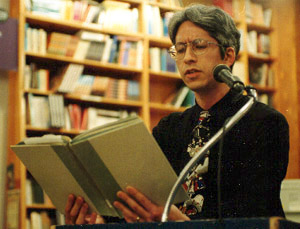
I do a lot of reading aloud: to my wife, to live audiences at bookstores and libraries, and for recordings that are broadcast over “Golden Hours,” a 24-hour service for blind and elderly housebound listeners overseen by Oregon Public Broadcasting. Among the writers I’ve read aloud to audiences at Powell’s Books, Borders, and the Multnomah County Library are Ray Bradbury, M.F.K. Fisher, John Donne, Gabriel Garcia Marquez, and F. Scott Fitzgerald. I recorded all 880 pages of The Stories of Ray Bradbury for Golden Hours. The photo at left was taken at Powell’s Books in early 1999 when I read from the works of Lewis Carroll, including not just excerpts from the Alice books, but Sylvie and Bruno and Carroll’s letters. (I passed on “The Hunting of the Snark,” which I do not particularly like.)
I still write and publish occasional free-lance pieces, and perform with my morris dance team, the Bridgetown Morris Men. Carole and I see a lot of movies, I do plenty of pleasure reading, and I write about books and films on AllReaders.com, AllWatchers.com, AllSciFi.com, and Amazon.com. You may also find my commentaries on the work of Harlan Ellison at several sites on the Web. (See Links.)
My book about men and pornography was published in January 2003. Although I authored two books in Boston in the mid 1980s, those were commissioned, in-house productions — I knew before I started them that they would be published. This one I thought up all by myself and wrote, then had to go out and sell to somebody, so I consider it my first real book.It’s already been reviewed by the San Francisco Chronicle, and I look forward to doing author’s appearances at Powell’s Books on March 11, Elliott Bay Book Company in Seattle on March 22, and other venues along the West Coast. See News to keep up with the latest developments.